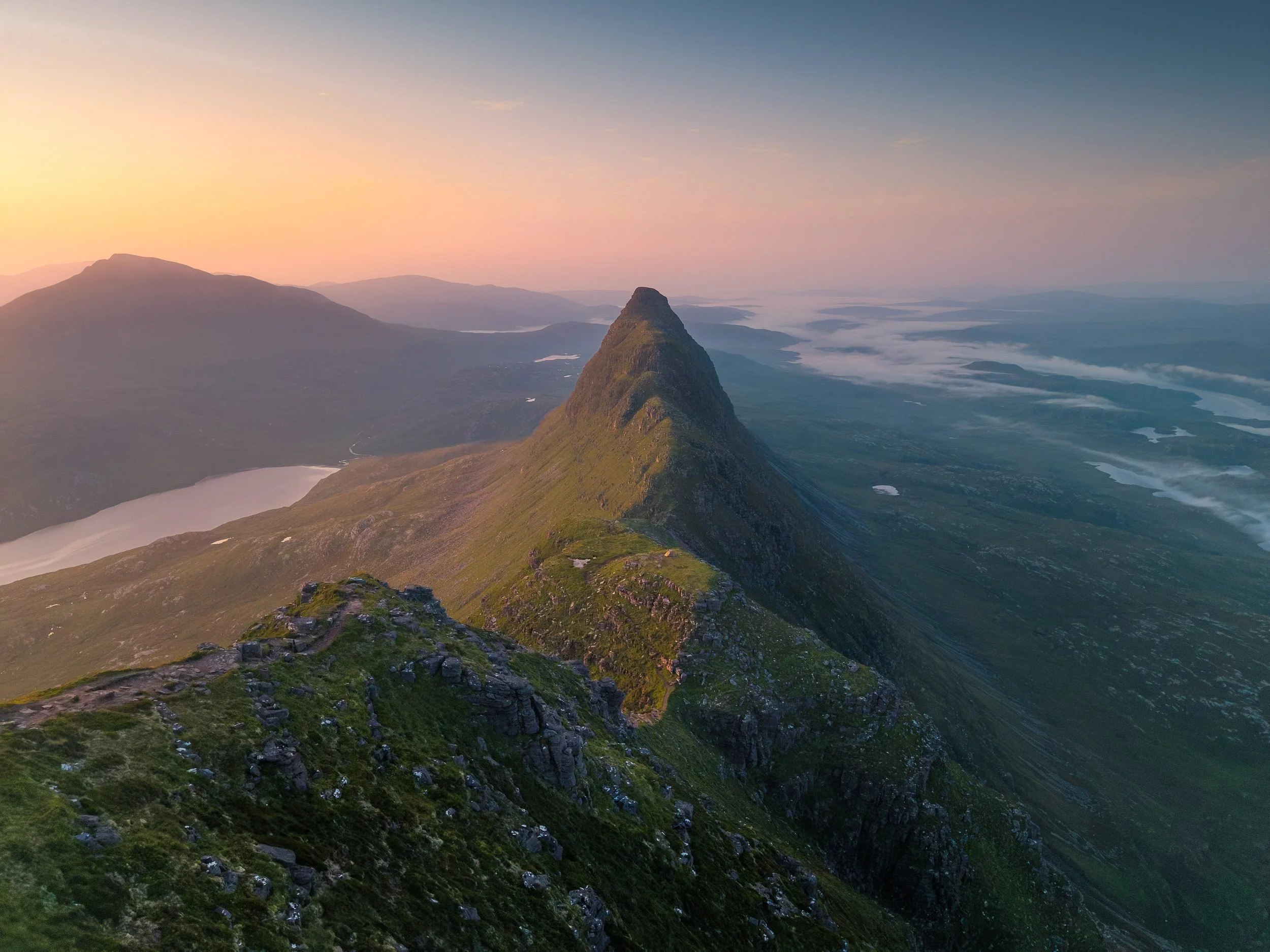
Suilven
A Summer Night on Suilven
Some mountains stay in your head long before you ever stand on them.
Suilven was one of those places for me. Its shape is so distinctive that once you know what you are looking for, it is almost impossible to miss. From different parts of Assynt, even from 30, 40 or sometimes perhaps 50 kilometres away in good visibility, you can recognise it immediately.
For a long time I had wanted to climb it and spend a night somewhere up there. There was something about this mountain that always felt a little different to me. Maybe it was the shape, maybe the isolation, or simply the fact that reaching it requires quite a bit of effort.
Eventually, it was time to find out what it looked like from the top.
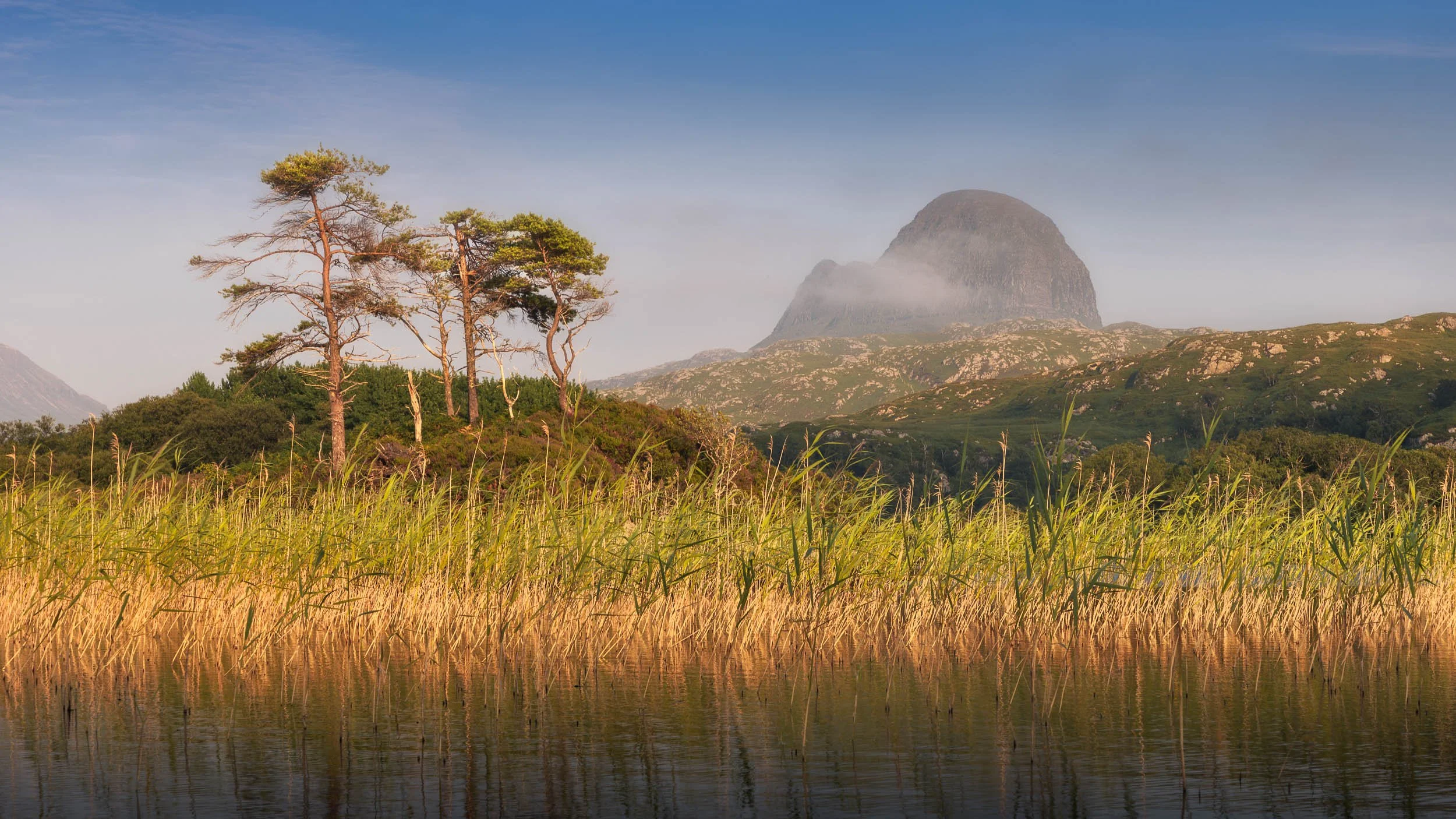
The landscape of Assynt on the approach to Suilven
The day we chose could hardly have been warmer.
We started the walk carrying heavy backpacks filled with camping equipment, camera gear, food and plenty of water. The full route from the car park and back is around 20 kilometres, and depending on pace and conditions it can easily turn into seven to ten hours of walking. Normally I enjoy documenting the journey as much as the final location. I like stopping along the way, looking for smaller scenes and photographing how the landscape changes as I get closer to the place I came for. This time I quickly lost any desire to do that. The heat was difficult enough, but the worst part was the horseflies. They were relentless.
Whenever we stopped, even for a short moment, they seemed to appear from nowhere. Within seconds they were landing on us and biting, sometimes even through our clothes. Taking the backpack off, getting the camera out and standing still to think about a composition simply stopped being worth it. After a while the only places where we wanted to stop were the slightly more exposed sections of the path. Out in the open, there was sometimes just enough breeze to keep them away for a few minutes.
Those little patches of wind became our rest stops. We could put the bags down, drink some water and finally stand still without constantly swatting at something flying around us. Then the moment we moved back into calmer air, they returned. By that point, photographing the walk had completely disappeared from my mind. I just wanted to keep moving.
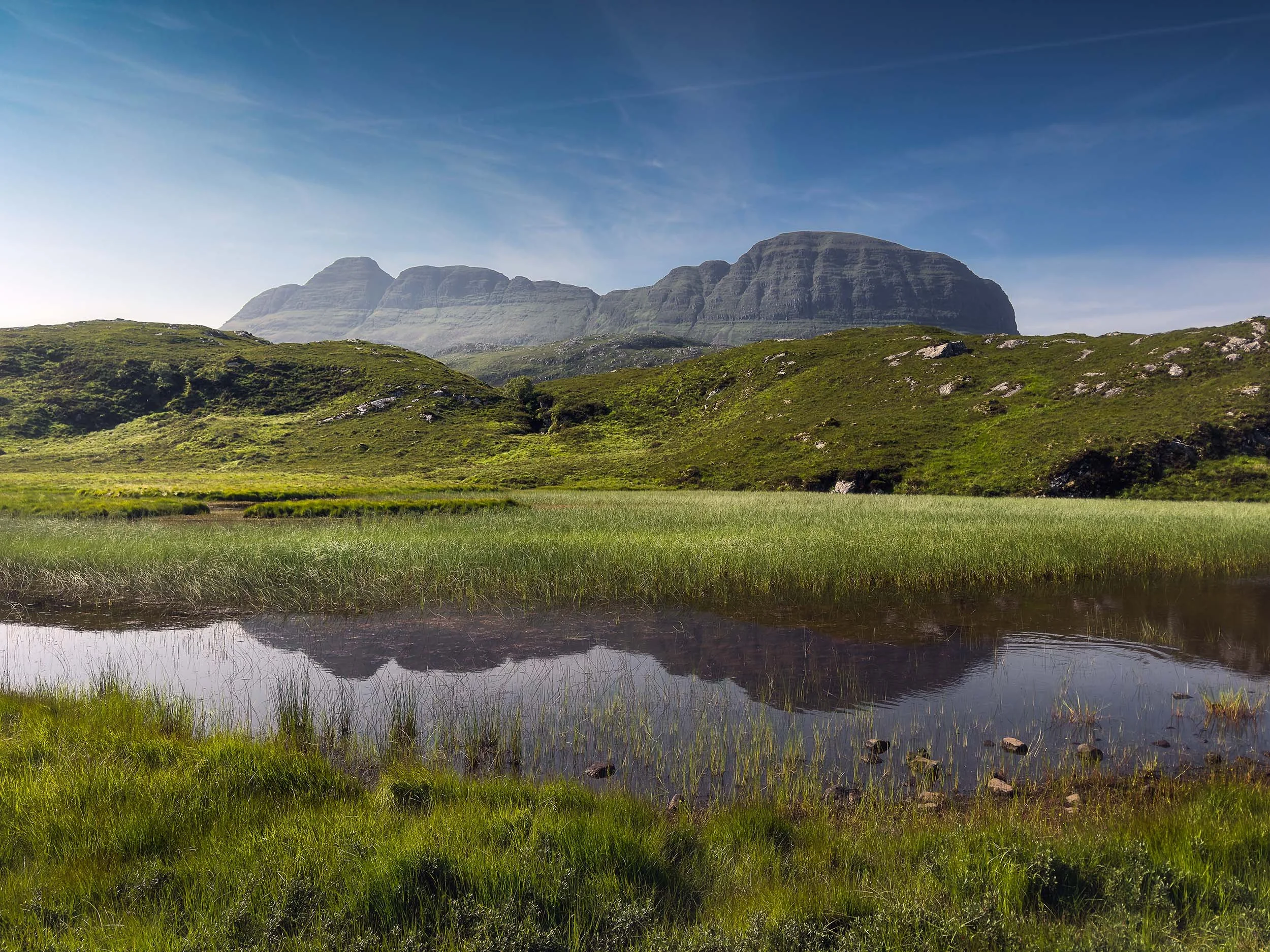
A quiet morning on the long walk into Assynt
By the time we finally reached the mountain, roughly three hours before golden hour, I was completely drained. I had imagined arriving with enough time to explore, look for compositions and enjoy the evening light. Instead, all I wanted to do was take the backpack off and sit down. I had almost no energy left for photography.
Eventually I forced myself to take the camera out towards the end of the day and photograph something, but I could feel that my head was not really in it. I was tired, I was not thinking properly about composition and the results reflected that. Sometimes you know immediately when you are photographing just for the sake of photographing. That evening felt exactly like that.
So instead of forcing it further, I decided to leave the camera alone and hope that some sleep would reset everything before sunrise. Of course, this was Scotland in summer. My idea of an early night was getting into the tent at around 11:30 PM and setting an alarm for 3:30 AM. Four hours. I barely slept at all. After how exhausting the previous day had been, setting an alarm for 3:30 AM felt like madness. When it finally went off, I felt anything but rested
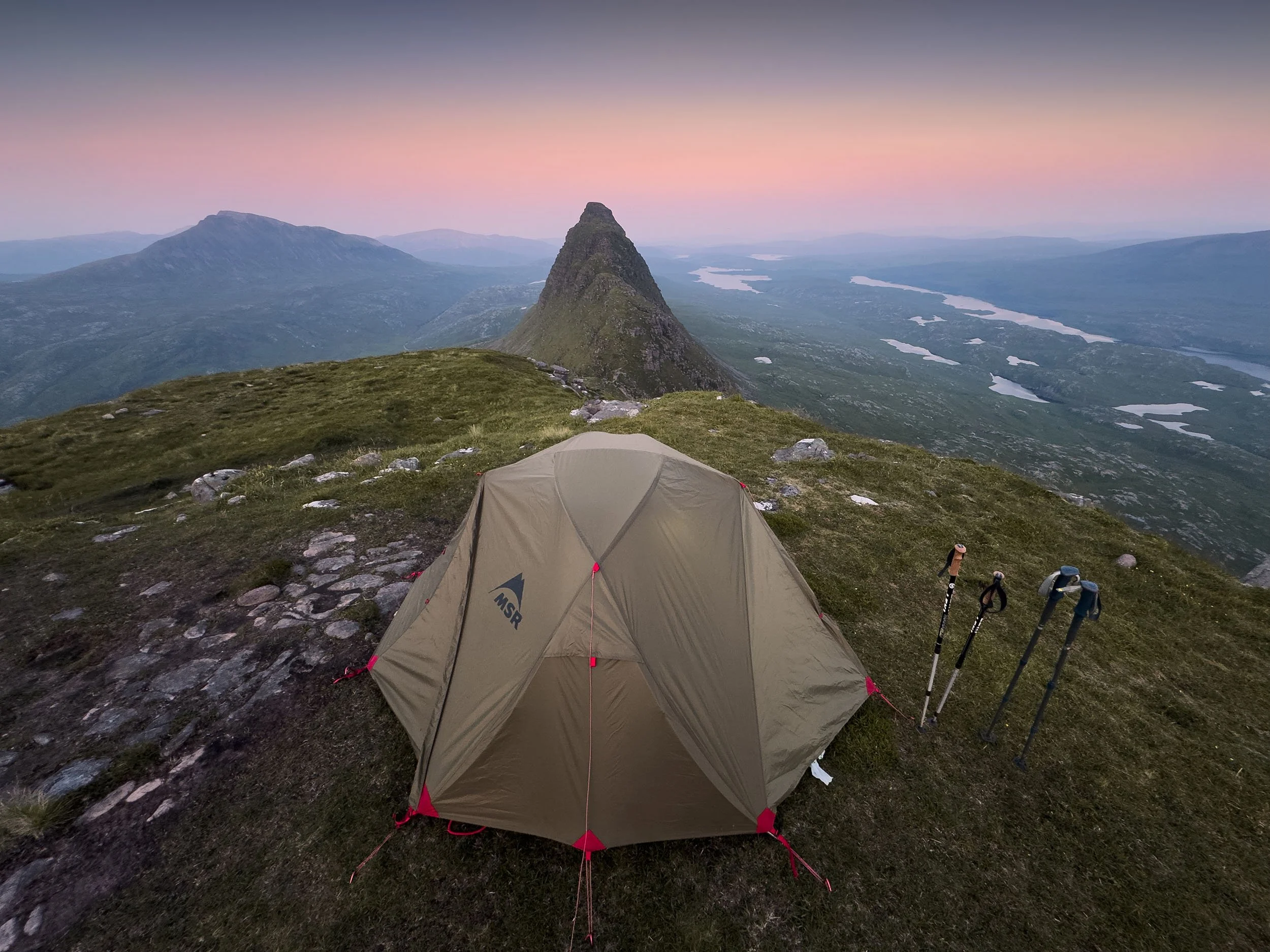
Our camp on the middle plateau of Suilven
The tent was pitched on the middle plateau of the mountain, surrounded by an incredible view. Even with the tiredness, it was difficult not to appreciate where we were. There are places where camping feels like simply finding somewhere practical to sleep, and then there are places where you unzip the tent and immediately remember why you carried everything up there. This was definitely the second kind.
If circumstances had been different, I could easily have stayed there for the whole following day and another night. But first there was sunrise. I woke up at 3:30 AM, got ready and waited. The epic sunrise I had imagined never really arrived. At dawn, heavy cloud stretched across the sky almost like a white sheet, blocking most of the colour and light I had hoped for. For a while it looked as if the morning might give me absolutely nothing. So I waited. And waited a little longer.
The first useful light did not appear until roughly 40 minutes after sunrise. Eventually the sun managed to break through the cloud enough to bring some colour and definition back into the landscape. It was not the dramatic morning I had pictured beforehand, but after the previous day and the early alarm, I was grateful to get anything at all.
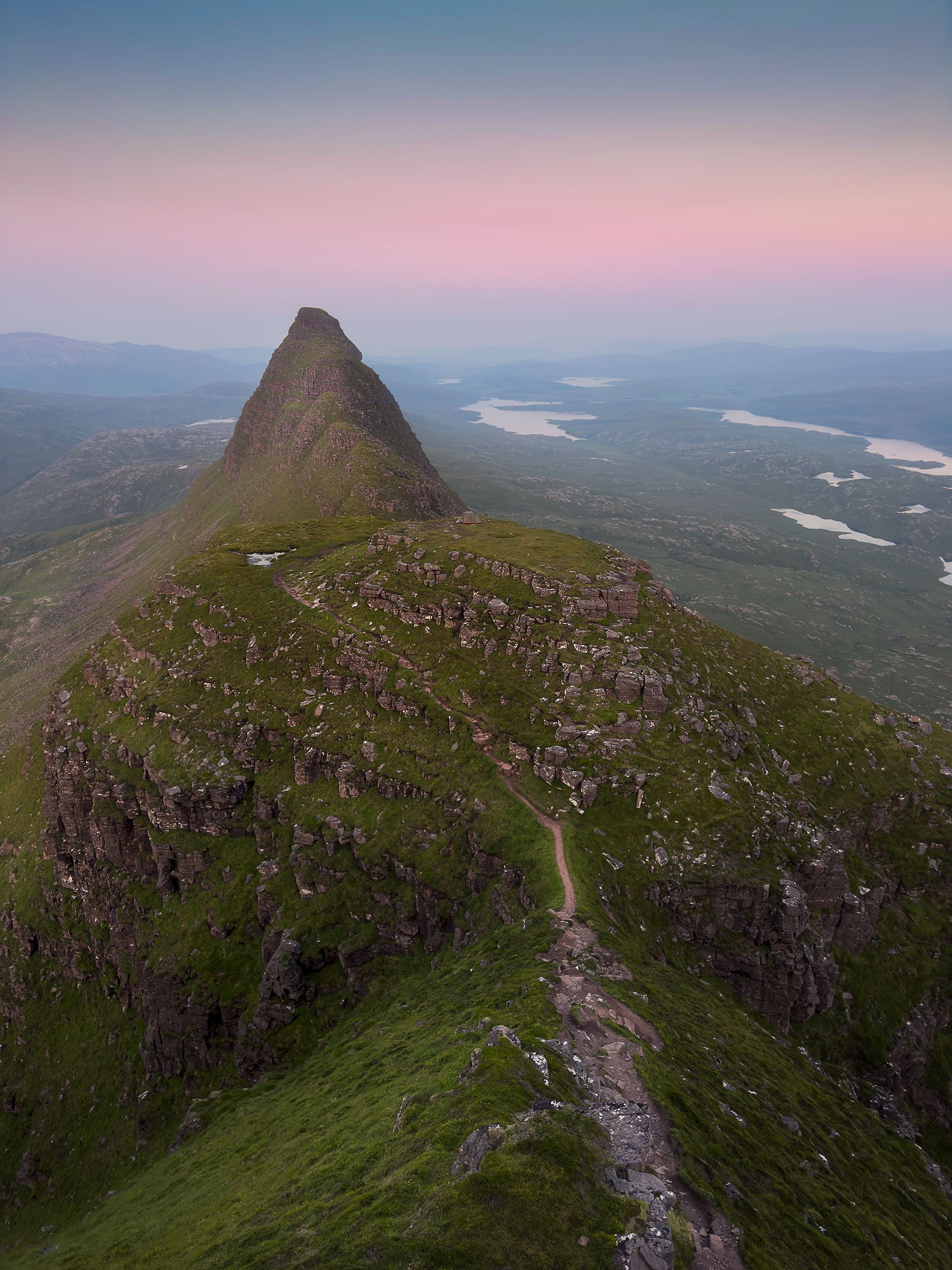
The ridge leading towards the eastern summit
At one point something even more interesting began to happen in the valley to the right. Low cloud started gathering below us. For a moment I thought I might finally see the inversion I had been hoping for. Watching cloud begin to fill a valley from above is one of those situations where it is difficult not to get excited. You start imagining what might happen if it keeps building. Maybe the entire landscape will disappear beneath it while the mountains remain above the cloud.
Unfortunately, nature had other plans. Instead of continuing to build, the cloud slowly began to disappear. A little later it was gone completely. That is landscape photography.
You can check forecasts, plan where the sun will rise and choose where you want to stand, but you never really control what happens once you are there. Years ago that would probably have frustrated me much more.
Now I find it easier to accept. If something starts developing, I work with it. If it disappears five minutes later, there is not much point getting angry about it. You look around and see what else the landscape is giving you.
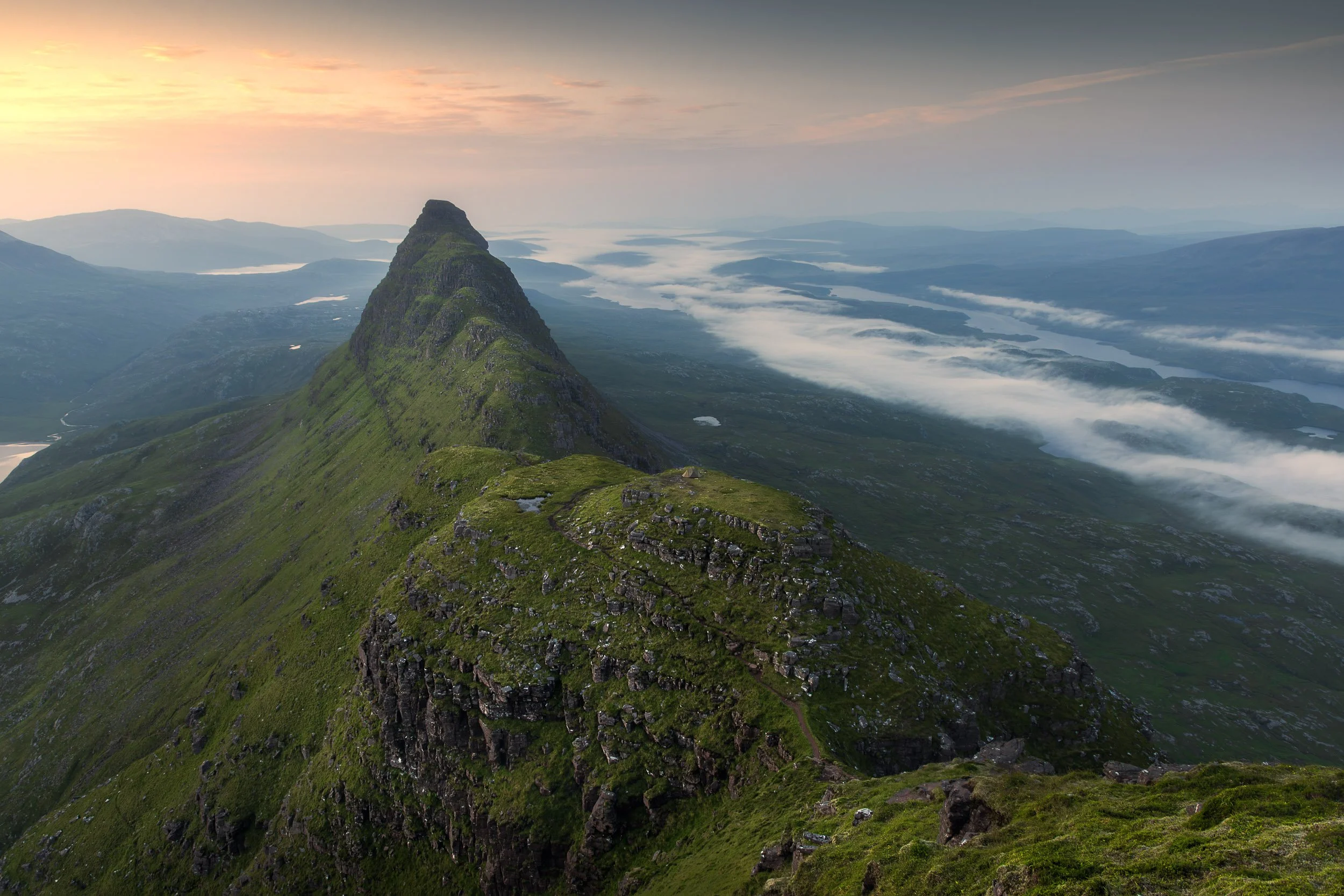
Low cloud beginning to gather in the valley below
Standing there also made me realise something I had not really expected. I am not completely sure that my favourite way of photographing Suilven is actually from Suilven. The mountain itself is magical, and I am very glad I finally climbed it, but one of the things that makes it so special to me is its shape.
From a distance, Suilven is unmistakable. It rises almost on its own from the Assynt landscape, surrounded by lochs, open ground and other mountains, but somehow it always seems to demand attention. From almost every direction its profile changes, yet it remains recognisable.
When you are standing on it, naturally, you lose that. Instead you get the huge landscape around it. And that is beautiful in a completely different way. Maybe that is why I still think some of my favourite photographs of Suilven will probably always be taken from several kilometres away.
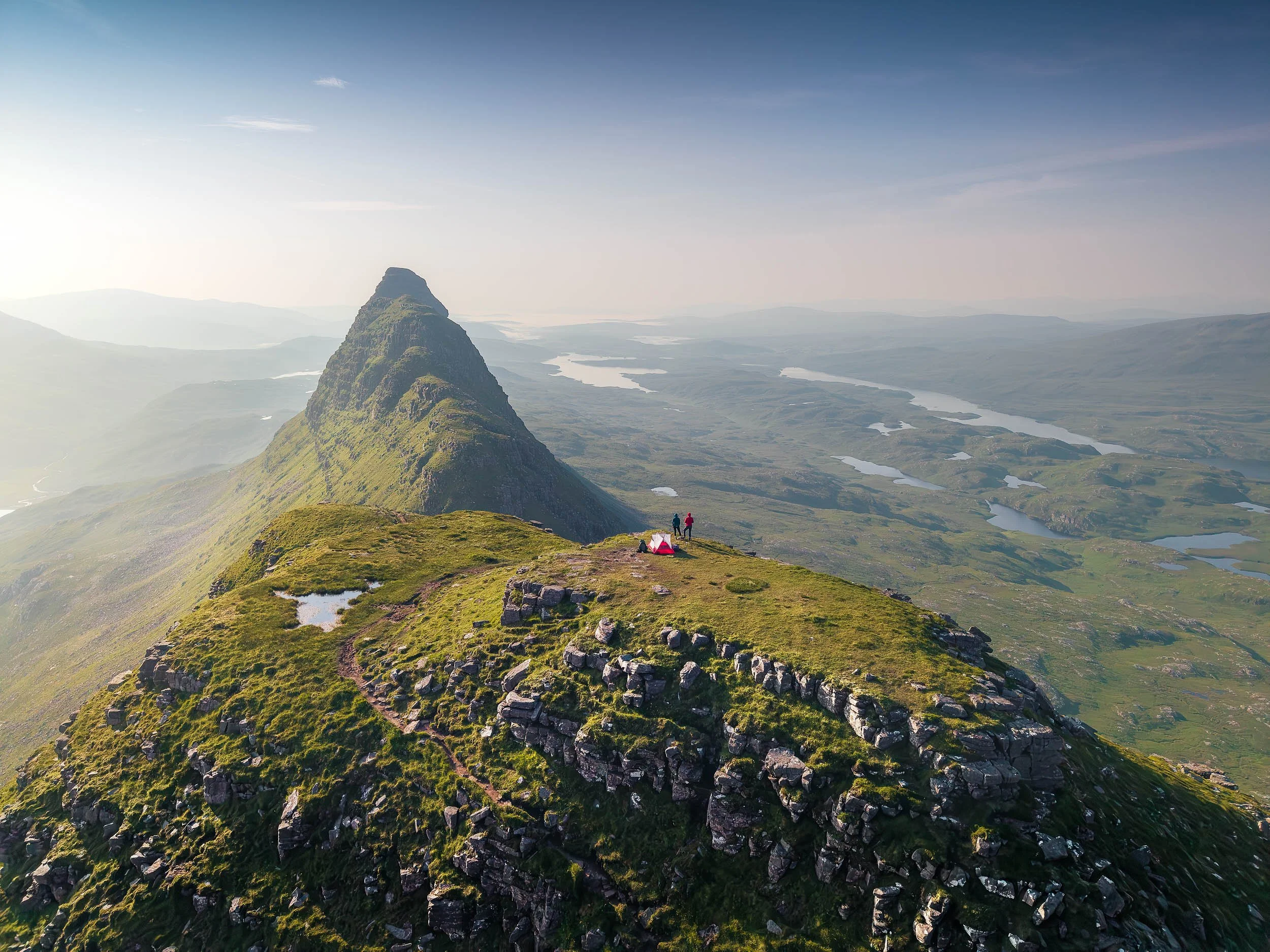
Looking down on our camp from higher up the ridge
For me, Suilven is still one of the finest mountains in the UK. Part of that feeling probably comes from the effort required to reach it. There is no quick stop at a viewpoint, no short walk from the car and no easy way to experience it properly. You have to walk into the landscape.
You have time to watch the mountain slowly getting closer, to see its shape change and eventually realise that the apparently impossible wall in front of you is actually where you are heading. From a distance, parts of the mountain look almost vertical.
The descent the following day somehow felt similar. Looking down from certain sections, it really did feel a little like walking down the side of a cliff. Strangely, though, the journey back was much more enjoyable than the walk in.
Maybe it was knowing that the hardest part was finished. Maybe it was having less pressure to reach somewhere before the light changed. Or maybe I was simply enjoying the landscape more now that I was not thinking about what photograph I was supposed to make next.
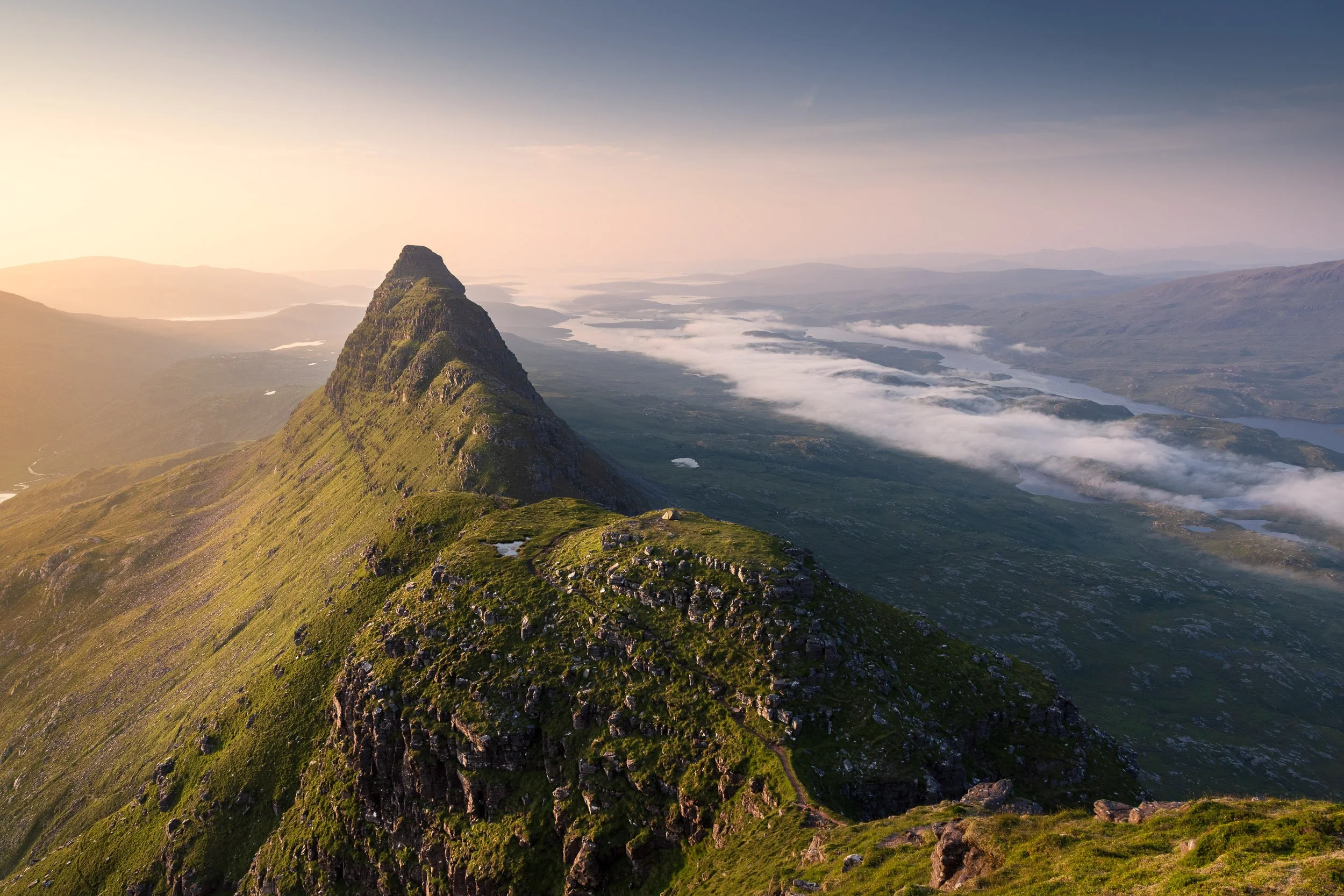
First light finally reaching Suilven
Another very hot day was coming, so staying for a second night unfortunately was not really practical. Part of me did not want to leave. I would happily have spent another day sitting somewhere on that mountain, watching the light move across Assynt and waiting to see what the weather decided to do. But eventually the tent had to come down, the backpack had to go back on, and we started the long walk towards the car.
Looking back at the photographs now, there are things I would change. There almost always are. I am probably more critical of my photography today than I have ever been, but I think that is also part of what keeps me improving. And with trips like this, the final photograph is only part of what stays with me anyway. I remember the heat. The ridiculous number of horseflies. Those small exposed sections of path where a bit of wind finally gave us a break. The heavy backpack. Arriving completely exhausted. Four hours of sleep. Waiting 40 minutes after sunrise for the light to finally appear. Watching the low cloud build in the valley and then disappear again. And waking up with the tent sitting high above the Assynt landscape. Those things are part of the photograph too.
When I first wanted to climb Suilven, I think I mainly wanted to stand on a mountain I had admired from a distance for so long. Now that I have done it, I am not sure the mountain has become any less mysterious to me.
If anything, I probably want to photograph it even more. Maybe next time from far away. Maybe from a completely different direction. Or maybe I will carry that backpack all the way up there again and give the sunrise another chance. Who knows. I would not rule out going back next year.